Thackeray’s Ode to Curry

Poem to Curry

- William Makepeace Thackeray (1811 -1863)

Three pounds of veal my darling girl prepares,
And chops it nicely into little squares;
Five onions next procures the little minx
(The biggest are the best, her Samiwel thinks),
And Epping butter nearly half a pound,
And stews them in a pan until they’re brown’d.

What’s next my dexterous little girl will do?
She pops the meat into the savoury stew,
With curry-powder table-spoonfuls three,
And milk a pint (the richest that may be),
And, when the dish has stewed for half an hour,
A lemon’s ready juice she’ll o’er it pour.

Then, bless her! Then she gives the luscious pot
A very gentle boil – and serves quite hot.
PS – Beef, mutton, rabbit, if you wish,
Lobsters, or prawns, or any kind fish,
Are fit to make a CURRY. ‘Tis, when done,
A dish for Emperors to feed upon.

Sound like the lady could be making Hannah Glasse’s curry – only with veal, no? A delightful example of 19th Century food porn poetry with big onions, little minxes, savory stews and hot pots. As an Englishman born and initially raised in Kolkata by parents both with ties to the East India Company, Thackeray wrote about something he knew well – curry.  Something to amuse you as we continue on our journey examining curry through foreign eyes.

For more on the proper (traditional) definition of food porn, see my post on The Lotus Eaters from 2010. (Words except cited verse by Laura Kelley.)

Indian Curry Through Foreign Eyes #1: Hannah Glasse

I have long been fascinated by concepts of “I and other”, or the many ways we separate what is familiar (self) from what is not familiar (non-self). By defining what is not self, we are in fact defining self. One can hear small children do this when misclassified by gender; most adamantly declare that they are not members of the opposite sex. “I and other” are also evident in beautiful symbolic ways when considering the movement of ideas and beliefs through societies. The newly introduced idea is at first foreign, complete with unfamiliar trappings. As the idea flows through society and is adopted, the foreign elements are shed and replaced by the familiar.

Depictions of Buddha: Caucasian and Asian

Depictions of Buddha: Caucasian and Asian

One place to see this is operation is at the Boston Museum of Fine Arts, which houses an expansive collection of Asian art. As Buddhism moves out of India and across Asia, first to the west and then the east, early iconography clearly depicts Buddha as Caucasian (Gandahara style), even if the work is from the Himalayas, Burma or Western China. As time passes, and Buddhist ideas are adopted across the east, however, religious iconography begins to depict a wide variety of races and ethnicities. Noses become smaller, epicanthic lids are added as the face changes from Caucasian to Asian. Expressions usually remain contemplative and serene, but the varying shapes of the faces are evidence of the triumph of the ideas across space and time.

The “I and other” concept is also of interest in historical cookery, especially when one group is attempting to recreate the cuisine of another. I’ve been looking at early recipes for Indian curry written by non-Indians. So far, I have a small collection of English and American recipes from the 18th and 19th centuries that show curry powders and recipes developing from recipes that merely reminiscent as Indian in the eighteenth century to those that are nearly indistinguishable from modern recipes broken out by geographical region by the end of the nineteenth. The earliest amongst them (so far), is a recipe from Hannah Glasse’s Art of Cookery made Plain and Easy, first published in 1747.

The Art of Cookery, 1774

The Art of Cookery, 1774 edition

Glasse’s book was an important book for its time and was a major reference for home cooks in England and its colonies for more than 50 years after its publication. If you think of it as an early Joy of Cooking, you are just about spot on. It was revised several times during her lifetime, but to avoid bankruptcy she had to sell the copyright and didn’t profit off of most of the sales.  The recipe for the chicken curry that I made below was added in a later edition of the book published in 1774.

The 1774 recipe reads:

To make a currey the Indian way.
TAKE two small chickens, skin them and cut them as for a fricassee, wash them
clean, and stew them in about a quart of water for about five minutes, then strain
off the liquor and put the chickens in a clean dish; take three large onions, chop
them small, and fry them in about two ounces of butter, then put in the chickens and
fry them in about two ounces of butter, then put in the chickens and fry them together
till they are brown, take a quarter of an ounce of turmerick, and a large spoonful of
ginger and beaten pepper together, and a little salt to your palate and strew all these
ingredients over the chickens whilst it is frying, then pour in the liquor, and let it
stew about half an hour, then put in a quarter of a pint of cream and the juice of two
lemons, and serve it up. The ginger, pepper, and turmerick must be beat very fine.

My interpretation of the recipe follows:

Hannah Glasse’s Butter Chicken (1774)

Ingredients
1 pound chicken breast meat, cut into bite-size pieces
3-4 tablespoons unsalted butter
1 large or two medium onions, peeled, sliced and separated
2-3 heaping teaspoons turmeric (the fresher the better)
2 heaping tablespoons ginger, grated or finely minced
2-3 teaspoons black pepper, freshly ground
1 teaspoon salt
2-3 cups low-salt or homemade chicken stock
½ cup heavy cream
¼ -1/3 cup fresh lemon juice

Method
Melt a couple of tablespoons of butter and when warm, add the chicken and sauté until the meat is opaque and starting to color. Remove chicken and set aside. If desired, add the remainder of the butter and then sauté the onions for 5-8 minutes, stirring frequently until they start to soften.

Add the ginger and if dry, add a small amount of the stock to moisten the pan. Sauté for 2-3 minutes and then add the pepper and salt and stir well. Cook for 5 minutes to allow flavors to blend, and then add the chicken and any accumulated juices back into the pan and stir well. Add stock to almost cover the meat and stir again. Cook to warm over medium heat, stirring occasionally. When warm, cover and reduce heat to so covered chicken cooks steadily at a medium simmer for 20-30 minutes or until chicken softens. Stir occasionally while chicken cooks.

When the chicken is tender, uncover and if necessary let sauce reduce a bit. When nearly done, reduce heat to lowest and add the cream and lemon juice and stir in well. Cook to heat and serve with rice or bread.
_____

I used breast meat, because my family doesn’t like to deal with bones unless necessary. Feel free to use chicken on the bone if you prefer, just adapt the cooking time so that the joints move easily and the meat is tender. I’ve also deliberately used a range of ingredients to allow people to adapt the recipe to their desired taste and consistency – that is a wetter or drier curry. Also, to get the most juice out of lemons, roll them well before cutting to break down the internal substance of the fruit before squeezing.
_____

Hannah Glasse Curry, 1774

Hannah Glasse Curry, 1774

The dish is very good, but not quite a modern curry. As you can see from the title of my interpreted recipe, the modern dish most like it is an eastern (Kolkata) butter chicken. However, the Hannah Glasse curry recipe lacks a full complement of spices and the varying amounts of tomato sauce now so often used in the dish. The turmeric and lemon juice are the dominant flavors, with the “heat” coming from the large amount of black pepper used. The heavy cream lends a nice touch that blankets the stronger flavors and tones them down a bit. I served the dish over a plain basmati spiced with a bit of black pepper and cardamom. All in all a delicious meal – and one of historical significance – good for both the body and the mind.

Other early recipes I’ve been working with include Mary Randolph’s 1824 recipes for a nutmeg and mace laden curry powder and her recipes for catfish and chicken curries. Another curry powder we’ve been sampling has been Mrs. Beeton’s 1861 recipe with cinnamon, fenugreek and mustard, which is more like a panchforan than a curry powder. I’ll be writing about these dishes in future posts, so stay tuned. Also, thanks to friend of the Silk Road Gourmet, the beautiful and talented Deana Sidney of Lost Past Remembered, I now have some early Dutch and Portuguese references to plow through looking for early curry recipes.

I will also be scouring earlier books for recipes that claim to be early Indian curries. If you know of any non-Indian recipes earlier than the mid-18th Century, please drop me a line or leave a comment with the reference.

Lastly, I will be on the road in May and may find it difficult to update the site, but please stay tuned for more curries and tales from Central and Western Asia when I return. (Words and adapted recipe by Laura Kelley; Photo of Hannah Glasse Curry, 1774 by Laura Kelley; other images in the public domain).

No Cuisine is an Island #1: An Indian Shellfish Curry

Shrimp or Scallops in a Spicy Tomato Sauce

Shrimp or Scallops in a Spicy Tomato Sauce

The booksigning at the Smithsonian went well. Actually it went very well – we sold and signed all but two of the books purchased for the event. I also really enjoyed meeting people and discussing the book with them. I was pleased to see that people were most interested in the book’s message that cuisines are interconnected, and how dishes we think of as cornerstones of national cuisines actually contain ingredients from all over the world.

To that end, I thought that a demonstration of how globally-sourced ingredients were combined for one of my favorite subcontinental dishes was in order. The recipe is for a delicious sweet, spicy, hot and sour shellfish that will amaze you. The recipe and description are followed by an analysis of ingredients and their origins. What seems like and Indian or subcontinental dish has connections to five continents and many more nations. It is truly global, and should be savored by all.

Shrimp or Scallops in a Spicy Tomato Sauce

Ingredients
1 pound shrimp, peeled, rinsed and deveined, or
1 pound sea or bay scallops
¼ teaspoon cayenne pepper
¼ teaspoon ground turmeric
1 tablespoon mustard or other seed oil
2 tablespoons peanut or light sesame oil
2-3 teaspoons fennel seeds
1 teaspoon yellow mustard seeds
4-5 hot, dried, red chili peppers, torn or chopped
1 large onion peeled, sliced, and separated into crescents
3-4 teaspoons garlic, peeled and chopped
¼ cup of water to moisten (more if needed)
3 teaspoons ground cumin
1 ½ teaspoons ground coriander
1 ½ cups tomato sauce
1 teaspoon tamarind paste dissolved into 2–3 tablespoons lemon juice
1 teaspoon salt
½ cup plain yogurt
1 medium bunch fresh cilantro leaves, chopped (20–30 sprigs)
¼ teaspoon Indian Garam Masala

Method
1. Shuck and devein shrimp or prepare scallops and place into a bowl with the cayenne pepper, turmeric, and a pinch of salt. Stir well, cover, and set aside for at least 1 hour.
2. Heat oil in a sauté pan over medium heat and when hot, sauté the fennel seeds for a minute or two. Remove from heat and let sit while shrimp or scallops marinate in the spices.
3. When almost ready to cook, reheat oil and add the mustard seeds and chili peppers and sauté for a minute. The mustard seeds may pop as the warm up, so you may wish to cover the pan, and shake to move contents. When done, remove from heat and let sit for five minutes.
4. Warm the sauté pan with the fennel and mustard seeds up again and add the onions and garlic. Stir and fry until the onions turn translucent and start to turn golden.
5. Add water to moisten. When water is warm, put in the cumin, coriander, and tomato and mix well. Cook 3–5 minutes to fully warm the spices.
6. Add tomato sauce, tamarind, lemon juice mixture, and salt. Cook to warm and add yogurt and cilantro leaves. Cover and gently cook for 15 minutes. Add garam masala and mix well. (The recipe can be paused here to allow other dishes to finish.)
7. If paused, reheat curry base and add shrimp and cook for 3–5 minutes or until shrimp are fully cooked. Serve immediately with rice or bread.

Now, here comes the fun part. The map below depicts where the ingredients from this dish hail from. Lines terminate only in rough geographic areas, not on specific places:

Origin of Ingredients for Indian Curry

Origin of Ingredients for Indian Curry

The only ingredients that originate in India are black pepper, cardamom and cinnamon, and they are all in the garam masala used to finish the dish. Important certainly, but in this dish, almost an afterthought. Turmeric may also originate on the subcontinent, but no one is sure whether that is the case, or whether it arose in Southeast Asia and was adopted in antiquity by the Indians.

From South America there are chili peppers, and peanuts in the peanut oil, and from North America there is the tomato, and possibly the cayenne pepper. From North Africa (Southern Mediterranean) there is black mustard seed in the mustard oil, and from East Africa there is the lovely, sour tamarind pod. From Southern Europe there is fennel and yellow mustard seed and from Asia minor there is coriander or cilantro. Onions and garlic probably hail from Central Asia (Turkmenistan to Kyrgyzstan) because that is where most of the genetic diversity in Allium species is found, and cumin is Western Asia’s gem, which has been flavoring dishes from ancient Mesopotamia to today.

Cloves and nutmeg used to round out the garam masala of course come from Indonesia’s Moluccas, and the dish is usually served on rice which comes from China’s Pearl River valley, but it can also be enjoyed with bread, or potatoes from the New World.

All of these ingredients made their way to India through movement of people and ideas or through trade and conquest. Some ingredients arrived deep in prehistory, and some are relative newcomers which only arrived in the middle or late centuries in the last millennium. The Silk Road was an important part of the spread of these ingredients and in the forging of links between cuisines and cultures.

To some degree, we tend to think of the world’s borders and biodiversity much as we find them today, but a simple exercise like this shows us that this is not really the case at all, and it hasn’t been the case throughout much of human history. With apologies to locally-sourced aficionados, eating-locally is a relatively modern concept when compared to the global nature of most dishes.

Cultures combine ingredients differently, but most cuisines include ingredients from places beyond their national borders. Each bite connects us with the past and with the people who often travelled great distances to bring variety home. Diversity is a wonderful concept, appreciate it the next time you enjoy a delicious curry or stew or koresh or bhaji or braise or . . . (Words and ingredient analysis by Laura Kelley; Photo of Shrimp or Scallops with Spicy Tomato Sauce by Celeste Heiter; Map of Ingredients drawn by Laura Kelley).

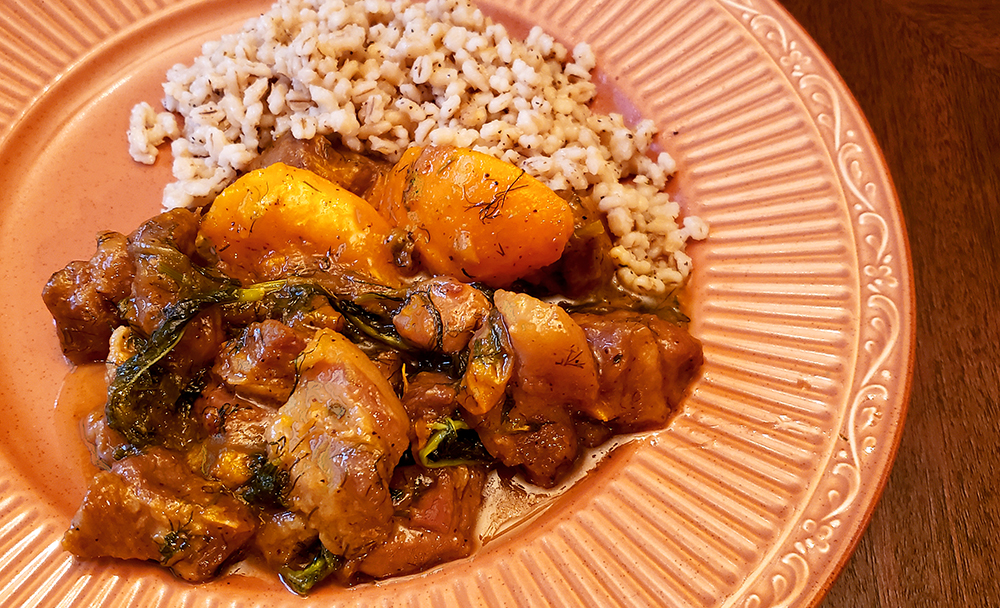
Ancient Roman Pork with Apples

Our trip to Moonfire Orchard left us with a wonderful selection of heirloom apples that I have been experimenting with. One of the recipes that I’ve been developing that is a real keeper is one for Ancient Roman Pork and Apples. It is an ancient recipe that balances sweet, sour, salty and bitter. And yes, it uses garum or liquamen so the umami factor for this one is through the roof! The recipe is from Apicius (4.3.4) and called Minutal Matianum in the original Latin.

One of the interesting things about the recipe is that the pork is twice cooked. Yes, this is one of the way that Romans prepared pork leftovers – by cooking them with leeks and apples with herbs, spices, garum, honey, vinegar and the grape syrup known as defruitum. The way I’ve been making it, it has a sweet and sour flavor that is reminiscent of an Alsatian Sauerkraut with Apples that is an old family favorite. But like most ancient recipes, the ingredients have no amounts associated with them, so a large amount of variation in flavor is possible. if you want it sweeter than I’ve written it – make it so! The original recipe and a simple translation follows. After that are my notes and my adaptation of the recipe.

ADICIES IN CACCABUM OLEUM, LIQUAMEN, COCTURAM, CONCIDES PORRUM, CORIANDRUM, ESICIA MINUTA. SPATULAM PORCINAM COCTAM TESSELLATIM CONCIDES CUM SUA SIBI TERGILLA. FACIES UT SIMUL COQUANTUR. MEDIA COCTURA MALA MATIANA PURGATA INTRINSECS CONCISA TESSELLATIM MITTES. DUM COQUITUR, TERES PIPER, CUMINUM, CORIANDRUM VIRIDEM VEL SEMEM, MENTAM, LASERIS RADICEM, SUFFUNDES ACETUM, MEL, LIQUAMEN, DEFRITUM MODICE ET IUS DE SUO SIBI, ACETO MODICO TEMPERABIS. FACIES UT FERVEAT. CUM FERBUERIT, TRACTAM CONFRINGES ET EX EA OBLIGAS, PIPER ASPARGES ET INFERES.

Put in a sauce pan oil, broth finely chopped leeks, coriander, small tid-bits, cooked pork shoulder, cut into long strips including the skin, have everything equally half done. Add Matian apples cleaned, the core removed, slice lengthwise and cook them together: meanwhile crush pepper, cumin, green coriander, or seeds, mint, laser root, moistened with vinegar, honey and garum and a little reduced must, add to this the broth of the above morsels, vinegar to taste, boil, skim, bind strain over the morsels sprinkle with pepper and serve.

Ancient Roman Pork with Apples

Ancient Roman Pork with Apples

One thing to keep in mind is that unless you cook Ancient Roman recipes frequently and have defruitum on hand, you will have to make it in advance. This simply requires boiling down grape juice until it becomes a syrup. Making defruitum is simple to do, but time consuming. Depending how much you are making, it can take a while and has to be done on low heat to avoid burning the syrup. I recently made a batch and boiled down 64 oz of juice to about 16-20 oz of defruitum. Although most recipes for defruitum say that it is boiled down by half, this is based on crushing fresh grapes and letting them sit in skins for a day or two before straining and reducing. I think that the crushing and sitting may change the consistency a bit when compared to the bottled 100% grape juice that I used. I went by the consistency which is lightly thickened and robustly flavored NOT a true syrup like sapa. I suggest making the defruitum a few days in advance of trying the Ancient Roman Pork with Apples recipe.

Also, as it is a, ‘what to do with leftovers’ dish, the pork has to be cooked in advance. If you don’t have a pound of pork leftover from your last feast, you can boil the meat in enough water to cover in the morning, let it cool and make this recipe at night. I’ve taken to adding some crushed peppercorns to the water to flavor the meat and it is a delicious touch.

For this recipe I used very large Gold Rush apples which have a powerful, complex flavor. It also keeps its shape during cooking, so the apples do not break down into applesauce. So, flavor is important when choosing apples, but form and ability to withstand cooking is also important.

This recipe also calls for garum or liquamen the fish sauce of the ancients.  If you have a vat on hand (as I do) harvest some and use.  If not, use some Asian fish sauce as an alternative.

Lastly, asafoetida has been substituted for laser root (silphion). Silphion is thought to be a now extinct member of the Ferula genus. Asafoetida, although offering a more crude onion-garlic flavor, is a the best substitute.

Ancient Roman Pork With Apples

Ingredients

1 pound pork shoulder or tenderloin, roasted or boiled and sliced lengthwise into strips
2 Tablespoons unsalted butter or olive oil
1/8 pound ground pork or beef
1½ tablespoons garum or fish sauce
3 leeks, cleaned and sliced in long thin strips, separated into white and green parts
3 teaspoons cumin seed, partially crushed
3 teaspoons coriander seed, partially crushed
4-5 long-pepper catkins, crushed
Handful of fresh mint leaves
1 small bunch, cilantro minced
½ cup beef or chicken broth or liquid from par-boiling the pork
1/3 – ½ cup white vinegar
2 tablespoons honey
2 large pinches of asafoetida
2 large firm apples, peeled and sliced lengthwise
¼ cup defruitum (reduced grape juice)
1 teaspoon cracked pepper for garnish

Preparation

  • Make defruitum. For this recipe use a white grape juice variety.
  • Harvest garum or buy fish sauce
  • If necessary cook and cool pork. If you do not have sufficient leftovers from a large pork roast, boil the meat in enough water to cover for 5-7 minutes and then cool in its juice. If boiling the meat, throw some additional crushed peppercorns into the water to season.

Method

  1. Place butter or oil in a large sauce pan and warm over medium or medium-low heat. Add ground meat and sauté – breaking up the meat into tiny tidbits as you stir. Add about 1 tablespoon of the garum, stir and warm. Add the white parts of the leeks and cover and cook for a few minutes until the vegetables start to wilt.
  2. Add cumin, coriander seed and long pepper all lightly crushed and stir. Add the mint, cilantro and stir again. Add broth or water from parboiling the pork to moisten the contents of the pan. Then add the vinegar and stir well while the liquid warms. Add the honey, remaining garum, and asafoetida and stir again.
  3. Add the pork and green part of the leeks, stir and cover to warm. When the pork has warmed, add the apples, stir and cover. After about five minutes add the defruitum and stir again. Cook another five minutes – or until the apples are just done – and remove from the heat. With this amount of liquid, I felt no need to bind the sauce with a roux or corn starch as suggested in th original recipe. If you wish to make a thick sauce, remove the solids from the pot and make a sauce. Otherwise, garnish with cracked pepper and serve. Excellent with barley or millet, or all by itself.

One of the things I like most about this dish is how it changes as you eat it. The combination of vinegar and the sugars from the honey and defruitum fill the room during proparation. When you first eat it (as written) the bitter turns to sweet, then there is that incredible savory of the garum followed by the sharp crack of all tthat pepper to form a perfect symphony of a dish.

Its a bit of work if you don’t have the defruitum on hand, but I hope you give this one a try – its a path back to an ancient Roman meal along the Silk Road. (Words and adaptation of Apician recipe by Laura Kelley. Photo of Ancient Roman Pork with Apples by Laura Kelley).

A New Oenogarum

Deciphering and reinventing ancient recipes is an inexact skill.  To some degree, it is more like alchemy than anything else.  There is a touch of science in the linguistic, historical or archaeological research; a touch of art in the choosing of ingredients and their relative quantities; and a touch of faith or intuition in what feels right from a culinary point of view.  The mark of the cook, chef or the interpreter and the decisions they made along the way is always present in the final dish.

As regular readers of the website know, many, or perhaps most ancient recipes have little or no information about the quantities of ingredients to add.  I believe that this is purposeful, to provide general flavor guidelines and allow cooks to decide what sort of dish is being produced from a soup to a braised dish to a roast etc.  Sometimes, however, the method is explicit: boil this, then roast, and there is little room for improvisation, although many cooks ignore these instructions when unfamiliar methods are proposed, as with boiling meats.

Long Pepper (Piper longum)

Another uncertainty is the surety of the cook with ingredients and their equivalency with modern ingredients.  For example, in most Roman texts, the word “pepper” is used in a generic sense.  It could mean black pepper, white pepper or long pepper (Piper longum).  In antiquity, long pepper was the most expensive and the most sharply flavored of the three, white pepper was gentle in flavor and intermediate in price and black pepper was the people’s pepper:  relatively cheap and strongly, but crudely flavored. The choice of the type of pepper depended upon the flavor desired for the dish, and the size of the diner’s purse.  Today, most cooks unfortunately interpret this ingredient to be black pepper and thus limit the variation potentially associated with the dish.

My Homemade Garum

One of the ingredients (or famiy of ingredients) in ancient Roman cookery that remains somewhat elusive for modern cooks is oenogarum.  That is wine mixed with the fish sauce garum or liquamen that is derived from fish digested with salt and its own intestinal enzymes.  Contrary to what many would expect, the garum or liquamen doesn’t bear a particularly strong fish or salt taste.  Rather it enhances the flavor of other foods with its high glutamic acid content.  (To read more about garum and my attempts to make it see this post and this post and check out the posts listed under the rubric Roman Cookoff.)  All this said, there are only rough descriptions of how to produce garum or liquamen in ancient manuscripts.  The type and amount of fish vary extensively as do the amount and type of salt and the digestion time.  Modern attempts to recreate garum or liquamen by myself and others (notably by historic cook Sally Grainger) are all equal parts research, opinion and intuition.  When all is said and done, we are all only approximating the Roman sauces, not really reconstructing them.

In ancient Roman recipes, oenogarum is used in two different culinary circumstances: 1.) In the kitchen to flavor foods and construct sauces, and 2.) As a condiment or dipping sauce at the table.  As an ingredient to sauces, oenogarum is mixed with many herbs and spices from lovage and pennyroyal to long pepper and crushed cloves depending upon the food item to be enhanced.  At the table, the ingredients tended to be more limited and sometime included a dash of vinegar, honey or a sweet and thick fruit or wine syrup.

A Glass of Roman Wine

Many problems surround the reconstruction of these sauces, but the biggest issue is we really have no idea what Roman wine was like.  Was it strong?  Was it sweeter or more sour than wines of today, and what quality was used in the kitchen for the construction of sauces?  From Pliny the Elder (NH 14.8) we know that a cup of Falernian wine would catch fire from a candle flame drawn too close.  From this we can assume that at least this variety was much stronger than our wines today.  We also know that some sweet wines were thoroughly enjoyed, especially some sweet white wines.

The ability to age was a desirable trait in Roman wines, with mature examples from older vintages fetching higher prices than that from the current vintage, regardless of its overall quality. Roman law codified the distinction between “old” and “new” as whether wine had aged for at least a year. Falernian was particularly valued for its aging ability, said to need at least 10 years to mature but being at its best between 15 and 20 years. The white wine from Surrentine was said to need at least 25 years.

In the manner of Greek wine, Roman wine was often flavored with herbs and spices and was sometimes stored in resin-coated containers, giving it a flavor similar to modern retsina.  Additionally, honey or must was added to some wines, such as Mulsum to enhance and sweeten their flavor before serving.  Romans were particularly interested in a wine’s bouquet or aroma.  One technique used to enhance the bouquet was to plant herbs such as lavender and thyme in the vineyards, believing that their flavors would pass through the ground and into the grapes.  Another widespread practice was the storage of amphorae in a smoke chamber called a fumarium to add smokiness to a wine’s flavor.

The finest wine was reserved for the upper classes of Rome. Below that was posca, a mixture of water and sour wine that had not yet turned into vinegar.  Posca’s use as soldiers’ rations was codified in the Corpus Juris Civilis and amounted to around a liter per day.  Still lower in quality was lora, which was made by soaking the pomace of grape skins already pressed twice in water for a day, and then pressing a third time. Cato and Varro recommended lora for their slaves. Both posca and lora were the most commonly available wine for the general Roman populace and probably would have been for the most part red wines.

Olivia Brion Pinot Noir, 2007

With all this uncertainty about garum and liquamen and an additional amount of uncertainty about Roman wine, one approach is to start anew in the recreation of oenogarum.  This is exactly what I’ve done with a little help from vintner, David Mahaffey, the genius behind Heron Valley Vineyard’s Olivia Brion wines. I requested David’s help, because who better than a master vintner to help
concoct a modern oenogarum.

Working with my garum and his own Olivia Brion 2009 Syrah, David came up with a formula pleasing to his modern expert palate. He chose the silky and concentrated syrah because he was cooking a wild boar shot on the vineyard grounds and thought that the red would work better with that meat. He writes, “After a little experimentation, I decided that the right proportional volume of syrah to garum was 225ml wine to 50ml garum–that seemed to have the right fruit to savory balance.” I find David’s choice interesting because many historical cooks use a 1:1 ratio, that for me, at least, is much too heavy on the garum. David’s ratio of about 4.5:1 (wine:garum) works extremely well from a culinary point of view as a sauce to prep dishes with in the kitchen.

I also find David’s choice of his syrah interesting from a historical point of view as well. Pliny the Elder wrote about the wines of Vienne (which today would be called Côte-Rôtie), where the Allobroges made famous and prized wine from a dark-skinned grape variety that was at that time new to the Roman world (NH 14.3). It has been speculated that it could be today’s Syrah, although some have argued that the description of the wine would also fit Dureza grapes. So good on you David!

Mushrooms with Oenogarum and Long Pepper

I used David’s oenogarum formula with a less expensive but good Shiraz to cook Mushrooms al la Apicius (7.8.15) to accompany a Roman lamb dish my husband served up that evening. The Apician recipe calls for the mushrooms (or, specifically morels) to be cooked quickly in garum and pepper and then drained. I used oenogarum and long pepper to make a nice side dish that worked very well with the lamb. The oenogarum enhanced the flavor of the mushrooms with a hint of the shiraz and also was the sole source of salt for the dish, and the long pepper added just enough peppery spiciness that worked wonderfully with the mushrooms (morels were not available locally for love or money so I used meaty, portobello caps). Mushrooms prepared thus could also be used in an egg dish like a kuku or an omelet, or mixed with other vegetables for another great presentation. One new oenogarum potion down, many more to go.

A Roman Mushroom Dish
(based on Apicius (7.8.15))

1 pound Portobello Mushroom caps
1.5 cups good Shiraz (or Syrah)
1/3 cup garum or liquamen
4-5 long pepper catkins, crushed or ground

Clean thoroughly and slice the mushrooms into bite-sized morsels and set aside. Mix wine and garum and mix well but gently.

In a large saute pan, warm the oenogarum and long pepper over medium-low flame until it is hot. Do not let it come to a boil. When hot, add the mushrooms. Cook uncovered until mushrooms have given off their own water and have become tender. Remove from flame and drain the mushrooms. If desired, catch the liquid from the pan and use it to flavor another dish for the same meal. Works very nicely with grain dishes such as barley. Enjoy!

(Words by Laura Kelley. Photo of Homemade Garum and Mushrooms with Oenogarum and Long Pepper by Laura Kelley.  Photo of Long Pepper from Wikimedia Commons; Photo of Roman Wine by Deana Sidney and Photo of Olivia Brion Pinot Noir borrowed from the Olivia Brion website.  Special thanks to David Mahaffey for beginning to help solve the ancient puzzle that is oenogarum.)

Ancient Roman Cookoff Entry 6: A Roman Roast Lamb Chop

My husband was drawn into the spirit of the cook-off again and prepared an elegant and delicious Roman roast lamb chop for us. He based his recipe on Apicius 8.6.8: The Raw Kid or Lamb: Haedus Sive Agnus Crudus. The original directions are about as simple as simple can be and read: “Is rubbed with oil and pepper and sprinkled with plenty of clean salt and coriander seed, placed in the oven and served roast”. He made one addition to the recipe. He sprinkled some garum on the just roasted chop just after taking them out of the oven to rest before serving to add some of the garum magic to the roast lamb.

Roman Roast Lamb Chops

Ingredients
4 large bone-in lamb chops
1-2 tablespoons olive oil
2 tablespoons black peppercorns
11/2 teaspoons sea salt
2 tablespoons coriander seed
1-2 teaspoons garum (if available)

Method
Grind the peppercorns by hand in a mortar. I usually prefer a coarse ground to a fine one. When ground to the desired degree, mix the ground pepper with the olive oil in a small bowl and let the pepper infuse the oil while you grind the coriander seed. When the coriander seed is done, mix it with the salt and set aside.

Pierce the chops several times with the tines of a fork and then thoroughly rub the oil and pepper mixture on both sides. Let sit for at least 20-30 minutes. Then rub on the mixture of salt and ground coriander seed on one side of the chops and place this side face down on the broiler rack. Rub the side facing up with the remaining mix and let sit for an additional 20-30 minutes. Preheat the broiler to high while the meat is being seasoned.

Place under broiler at least several inches from the flame and cook 4-5 minutes a side; adjust cooking times to size and thickness of the chop. When done, remove from broiler and sprinkle garum over the chops. Let rest at least 5 minutes before serving.

__________

Steve writes: Back when Laura started her garum experiment, I got interested in some of the things that she was cooking. I’ve always liked historical cooking and so decided to try some things on my own. However finding a recipe that would not take me all day to cook AND that could feed our kids as well as ourselves was a challenge. I came across a version of this recipe for roast lamb and it seemed simple and would not require a lot of unusual ingredients, but would allow me to experiment with the garum as an addition. As we found with other recipes, the garum does not give the food a fish flavor, but instead enhances the flavors that are present in the dish. Even our kids, who are notoriously finicky, enjoyed it and didn’t notice the garum at all. (Words by Stephen and Laura Kelley. Photo of A Roman Roast Lamb Chop by Laura Kelley).

Variation in Roman Cooking: The Tale of the Cucumber and the Melon

This post recounts the results of an experiment that took place recently between me and my husband.  In the Apician cookbook there are two recipes very close together that can be used for either cucumbers or melons:

PEPPER, PENNYROYAL, HONEY OR CONDENSED MUST, BROTH AND VINEGAR; ONCE IN A WHILE ONE ADDS SILPHIUM. (Apicius III.6.3 (for cucumbers) and III.7.1 (for melons))

Ingredients are listed, but no amounts are offered. My husband, who is also a good cook, wanted to join me in the cookoff.  So I proposed using our different takes on the cucumber-melon Apician recipe to demonstrate the role of variation in Roman cooking.  We cooked our dishes separately, and did not compare notes until after the experiment was over. Interestingly, we came up with radically different dishes based on the same ancient recipe.  The results follow:

__________

Apician Cucumbers by Laura Kelley
This is a slightly sour starter salad or condiment in a large meal that has the unusual flavor of red wine must and vinegar as the main flavors.  The pennyroyal sweetens the mixture just a bit and the asafetida adds a bit of depth.  The garum of course is the umami factor for this unusual combination of flavors.

Ingredients
1-2 large western cucumbers (or multiple smaller Asian ones)

Dressing
3 teaspoons dried, shredded pennyroyal
2 teaspoons coarsely ground black peppercorns
2 tablespoons beef broth
2 tablespoons olive oil
2 tablespoons red wine vinegar
3-4 teaspoons reduced red wine *
4 teaspoons garum
1-2 pinches asafetida (optional)

Apician Cucumbers by Laura Kelley


Prepare the dressing by whisking all of the ingredients together in a shallow bowl or cup.  If you are sensitive to textures, you may wish to grind the pennyroyal into a powder.  Peel, deseed and cut the cucumbers crosswise.   Pour dressing over the cucumbers and mix well.  Refrigerate for at least 1 hour.  When about to serve, add the asafetida if desired, and mix well.  Serve cool, not cold or at room temperature.

* Reduced wine or must is very simple to make.  For reduced wine, simply heat wine to a near boil, then turn down the flame to low or medium low and cook very gently – stirring often – until light syrup is formed.  For reduced must, use procedure above on commercially available 100% grape juice – unless you live near a vineyard and can get a large amount of fresh must.  Best if prepared at least one day before cooking and allowed to fully cool before using.  Stores for months if refrigerated in a sterilized, sealed glass jar. 1.5 liters of wine makes about ¼ to 1/3 cup of must.  (Reduced wine and must carry a wallop of sweet and sour flavor and should be used cautiously, or they will easily overpower and recipe.)

__________

Apician Melons by Stephen Kelley
This melon recipe is surprisingly sweet given the addition of so much white vinegar.  It provides a delicious and remarkable dessert or sweet snack of melons flavored in an unusual way – with sweet pennyroyal and lots of black pepper.  Best when served cool or room temperature – but not cold.

Ingredients
½ honeydew melon
½ cantaloupe

Dressing
3 teaspoons dried, shredded pennyroyal
2½ teaspoons coarsely ground black peppercorns
6 teaspoons white vinegar
6 teaspoons reduced white wine
4 teaspoons garum

Apician Melons by Stephen Kelley

Prepare the dressing by whisking all of the ingredients together in a shallow bowl or cup.  If you are sensitive to textures, you may wish to grind the pennyroyal into a powder.  Peel, deseed and dice the melons and mix them together.   Pour dressing over the melons and mix well.  Refrigerate for at least 1 hour.  Serve cool, not cold or at room temperature.

__________

First off, let me say that both dishes were delicious. We were both surprised to see what different dishes we made from the same list of ingredients. As you can see, to some degree, our preconceived notions about what to do with the main ingredient greatly influenced our choices.  Working with the cucumber, I went for a more sour, salad-like dish, and my husband went the dessert route becasue he was working with melons.

We both used reduced wine instead of reduced must (which would usually be slightly sweeter) or honey because that is what we had on hand.

We were also impressed by the absence of any fish flavor on the vegetables and fruits despite a fair amount of garum added to each dressing. I am not a big fan of dishes with a strong flavor of alcohol in them and particulary dislike rum cakes and tipsy parsons. That said, however, the rich flavor of reduced wine on the cucumbers and melons was fantastic and I urge you to try it.

Those of you who follow this blog will know that I pay a lot of attention to variation in Asian “recipes” many of which are offered as rudimentary lists of ingredients, just as the Roman recipe above. To sum up some of the posts I’ve written on variation, which are available here and here, I’d note that most of the rest of the world doesn’t care about the uniformity that so many in the west desire.

For example, many recipes in Central or Western Asia are given with the ingredient, “greens”. Most of the time this could be cilantro, parsley, tarragon, dill or even one of the savories – the varying balance of which could drastically change the flavor of a dish. A modern western version of such a recipe would, on the other hand, report the exact amounts of the herbs needed and the form in which to add them. This would lead to a single taste for the recipe, instead of a range of variation. A loss, indeed.

When Asians without formal culinary training are queried about how much of an herb is needed in a recipe, most don’t even understand the question. They shrug and say something like, “however much you wish”.

I find it interesting that many Roman recipes work like many modern Asian ones. We found out in the Mesopotamian cookoff that some dishes – like mersu – could take on many different forms by mixing and matching ingredients according to the diners likes and dislikes, wishes of the cook, their skills, and what they had on hand. Both ancient and modern recipes are part of the legacy of the Silk Road which still influences our world today. (Words by Laura Kelley; Recipes by Stephen and Laura Kelley as noted, and Photographs of the Apician Cucumbers and Melons by Laura Kelley).

They Went That-a-Way: How the Roman Emperors Died

Derek Jacoby as Claudius I

As fitting to the Roman Cookoff as the Mesopotamian Rap was to our exploration of that culture’s cuisine, is a recent post by Josh Fruhlinger on how the Roman emperors died.

Sure the job had perks, but it also had real pitfalls as well.  Murder and assassination are by far the most common causes of death for the emperors with some of the killings being both horrendous and creative – like Valerian’s death by having molten gold poured down his throat.

Fruhlinger rates the deaths of the emperors by how, “hard core” their deaths were, with natural causes being low on the scale and Valerian’s death as noted above rating the highest – possibly because he was also used as a human footstool by the Persian Emperor and was taxidermied after death.

In a desperate effort to keep this relevant to a food site, I note that Claudius I died by ingesting poisoned food probably given to him by his wife (and niece) Julia Agrippina who was also the mother of Claudius’ successor, Nero.

(For those of you who like this sort of thing, I recommend to you Malcolm Forbes’ book entitled, “They went that Away” which recounts how some famous men and women from history died. An enjoyable, easy read. (Words by Laura Kelley; Photo of Derek Jacoby as Claudius I borrowed from the internet.))

Ancient Roman Cookoff Entry 4: Mixed Meat Patella by Sally Grainger

For our fourth entry in the Ancient Roman Cookoff, we have none other than Sally Grainger cooking for us. Sally is author of Cooking Apicius: Roman Recipes for Today and with historian Andrew Dalby, she is co-author of the The Classical Cookbook and its recently revised edition. For her entry, she chose a patella of mixed meat. The original recipe calls for tidbits of fine meats to be used. In her case, she used, pheasant, chicken, lucanika sausage, pork belly, king prawns and monkfish.  Sally layered these meats, along with eggs and spices in between layers of dough or bread, roasted and then cut into pieces for service.

Sally found a number of surprises, including how good it tasted after it was baked together after construction.  She writes, “You make an Apician patina like this: pieces of cooked udder, flaked fish, chicken meat, figpeckers, or cooked breast of thrush, and whatever finest qualities things there may be . . .

Dice all these carefully apart from the figpeckers. Beat up raw eggs in oil. Pound pepper, lovage, pour on liquamen, wine, passum; put in pan so that it warms through and thicken with starch. Before this however put all the chopped meat in and bring it to the boil. When this is cooked, take it out with its sauce and ladle it into a dish in alternate layers with whole pepper corns and pine nuts in such a way that, with each layer, you spread out a ‘double layer’ like a lagana (clearly actually ‘a lagana like a ‘double layered (cloak). Fill as many ladles as lagana you put in and put (the mixture) on top. Then pierce one lagana with a reed and put it on top. Sprinkle with pepper. Beforehand you should have thickened the meat mixture with the broken eggs and put it in the pan with the seasonings (Apicius 4.2.14) The kind of bronze pan you aught to have is shown below.

Ancient Roman Patina

I have cooked this recipe many times before and done so with the firm belief that it was not a forerunner of the lasagne and so it didn’t go back in the oven. In remaking the patina Apician for the cook off It seemed like a good idea to be a little more adventurous and try a number of different way to cook and serve it.

This is quite a perplexing recipe and made more so because the information seems to have been dictated. It is quite common in Apicius to find confusion as to the order in which you work because the cook has forgotten to add a key instruction until the end. There seem to be two ways to tackle the recipe; either treat it as an early version of lasagne and use pasta sheets where lagana are required or, as I do, consider pasta rather anachronistic at this time and use some thing other than pasta: un-leaved bread is the actual translation of lagana in classical Latin. I also note that it is whole-wheat flat breads that the famous Oliveto restaurant in Oakland used when they made this dish for their Roman inspired menu.

It is not just a simple matter of cooked pasta or cooked bread of cause as the structure and finished appearance of the dish rather depends on whether the layered sheets and sauce is returned to the oven and/or left in the dish. If the layering material is pre cooked it might suggest not. This recipe does not state either way but the following recipes in Apicius for an ‘every day patina’ indicates that the very same kind of structured dish is turned out of the vessel onto a ‘discum’ or platter for service (Apicius 4.2.15). Why it should be made in a bronze vessel and then turned out again without being further cooked is some what strange of cause. Another question that is not easy to answer is how is a portion is served to the guest? Is it cut like a cake or are the layers removed individually? I believe the answer to this is connected to the meaning of the ‘double layered cloak’ a most perplexing phrase. I have elsewhere published my thoughts on this issue in my edition of Apicius I came up with a number of scenario’s all of which I shall attempt to duplicate for this cookoff.

Bread for Patina a la Sally Grainger

I used a simple chapatti recipe for the bread and cook them on a metal bake stone over charcoal. An interesting phenomena associated with chapatti is the ability of the bread to puff up creating a steam pocket as if the bread was leavened. This may be the simple explanation for the double layered cloak. However as they cool they tend to deflate which is less convincing. The wonderful concept of using whatever good things are available also makes the dish very flexible. I have pheasant, chicken, lucanika sausage, king prawns and a firm fleshed fish such as monkfish or shark/tuna As to the sows udder: the ancient practise of consuming this organ either before or soon after the piglets are born is an unfortunate practise. However the majority of a sows belly around the in-active udder is in fact belly pork and this will suffice as an alternative.

I have made fish sauce myself in the last few years and used my own for this recipe. It has a salt level of c. 15% and a protein of 10% and was made from whole mackerel. Because it has a relatively low salt level I find I can use it quite liberally without the salt overpowering everything else. It is not overly fishy either with complex meaty cheesy overtones.

The Bread

This recipe makes roughly 12 chapatis like breads.

1 cup wholemeal flour
1 cup plain flour
salt to taste
water to bind
2 tablespoons olive oil

I used a preparation and cooking method derived from chapatti production.

For the Sauce:
500ml white wine
250ml stock made using the meat juices
150ml Muscat de Beaumes de Venise or similar desert wine
3 tablespoons fish sauce
2 level coffee spoon roasted and ground lovage seeds
generous fresh ground pepper
4 eggs
60ml olive oil

The Filling
2 120 gm chicken fillets
1 small pheasant
300 gm belly pork strips
2 lucanika sausages or any high meat content sausage of choice
100gm large prawns
100gm monkfish

The dough is formed with sufficient water and with oil to make a firm dough which is kneaded lightly and rested. I made some bread on the hearth with a bake stone and charcoal fire while also using a heavy non stick frying pan for others. I divide the dough into 12 balls and covered the remainder while I worked with each one. The pan needs to be heated on medium heat until a small piece of flattened dough takes on a little colour when it cooks rather than staying pale or burning. Take each piece of dough, flatten it and turn it in flour then roll/stretch to a round thin disk about 15-18cm. As each one is prepared it is immediately placed on the dry pan and turned after about 2-3 mins. After turning take a clean tea towel and press gently on one side of the bread and you will find the other side will puff up nicely  After a couple of minutes only remove the bread and wrap in a tea towel so that they don’t dry out.

I decided to pre cook all the meats in advance to generate a stock so that the meat flavours will be concentrated. I also feel that this kind of dish was actually designed to use up left over pre cooked meats from previous feast. Roast the pheasant and belly pork, strip the meat and dice. Poach/roast the chicken fillets and retain the cooking liquor. Cook the sausage. Flush out all the roasting tins with the chicken cooking liquor and make up to 250 ml with water. This along with the wine, muscat, lovage, my fish sauce and plenty of pepper was heated and the diced meat put in. After a brief re-boil I added starch – I actually had some wheat starch that a friend had made according to the instruction for making amylum in Pliny HN 18.76 and also Cato 87. This requires grinding as it is in the form of hard crystals. Corn flour is obviously a suitable alternative. I added the raw fish at this point cut into small pieces so that the remaining heat could cook the prawns and monkfish without them becoming too tough. I then added the oil and eggs. I was unsure about numbers but in the end found 4 more than enough. It was gently brought back to heat though not boiled as I didn’t think a curdled mixture was desirable. It did become quite thick but not set or solid. The instructions to ladle the mixture suggest a semi liquid.

Mixed Meat Patella by Sally GraingerGrainger

There was no possibility of a bronze patella sadly but a large straight sided casserole suited. I also decided to cut the bread to fit the dish. I feel that the bread makes the dish sturdy enough to be turned out and to be free standing. Any attractive layering would not be lost if the bread was left unevenly circular. To my shame I wasn’t able to achieve perfect circles!

The first method was the simplest and involved laying bread and mixture down in alternate layers with the pine nuts and pepper until full. It then of cause becomes necessary to consider why the bronze patella was used at all if it is not to be returned to the oven, if only to keep warm or more likely to further set the egg. As it turns out I did place the dish, covered, in the oven for 20 mins at 160 °C to see what would be the result. The result was quite remarkable. The patina turned out easily and looked quite spectacular Firm to the touch and distinctly wobbly like a mouse. While still hot it could be cut into wedges but they were just too soft to be picked up.  However after half an hour to rest, the cake for that is what its looks like, could be cut and the resulting wedge were warm and the bread at the top and bottom remained dry and the fingers stayed clean. It even looked like a very elaborate many layered sandwich and the reed in the top made it almost like a club sandwich! This above all else leads me to the inevitable conclusion that the dish could have been put back in the oven and served in wedges like cake.

Mixed Meat Patella – sliced

The alternative method which has been my preferred method in the past involved dispensing with the bronze patella and layering the sauce and bread as before or in separate individual sandwiches. So you had bread, sauce,bread,bread, sauce, bread, bread, sauce, bread, bread etc. It didn’t look bad and could be cut like the other one but was also readily removed and rolled up like a wrap and eaten while staying clean. My premise has always been that, as lagana was bread, the dish had to be associated with eating with the fingers and keeping them clean. If the finished item was too soft and wet at the time of service the breads main role would have been lost.

I had 10-15 portions to dispense with so shared the finished dish with a group of friends from our village who had not eaten any Roman food before and were nervous but declared it wonderfully. I have always loved that sweet lovage/umami combination in what is a very simple and apparently untypical Roman sauce. In comparison to some Roman sauces this has quite modern and European in flavour. The additional flavour from the meat stock made all the difference and I guess if the sauce was made precisely as instructed without the concentrated caramel meat flavouring it would have been a little less flavoursome. The white fish tended to disappear into the rest of the ingredients but the prawns were distinct as was the belly pork. It’s a hearty meal and one I shall reprise again for my next Roman dinner party. I have a hankering to open my own underground Roman restaurant in my home. When and if I do I shall make sure to use the social media to announce it so watch the web.”

__________

Sally’s interpretations of this patella is intriguing and delicious, but, the recipe lacks so much detail (by today’s standards) that a great deal of interpretation and creativity is allowed.  For example, another way to prepare the patina would be to explore a variation on the lagane or “double cloak” idea and to lay down two layers of cut noodles or thin-pancakes cooked by different methods: for example and oven-roasted layer and a fried-layer.

We don’t know what the shape of ancient lagane were, whether they were pancake or chapati like or whether they were sheets of dough that were then cut like noodles. We do know that the Etruscans were eating them and didn’t boil them. Rather they were cooked over coals or fried. Boiled “pasta” may be a Muslim invention – the first written reference to it is at least in Arabic. Modern lagane from central and southern are broad flat noodles like wide tagliatella that are sometimes ruffled and sometimes not. They are made from durum wheat or the finer 0 wheat flour, water and salt. Ancient lagane were probably made from spelt, possibly with farina or semolina added.

Today these are enjoyed in soups with chickpeas and other legumes in Campagnia (as referenced in Horace) or in a mixed-meat ragu in Puglia which could be a descendant of the Apician recipe above (minus the layered construction and with tomatoes and a modern retinue of spices added). In some areas, lagane are cooked in goat’s milk instead of water or broth on Catholic saint’s days. Another way lagane are enjoyed today are fried and layered as a sweet preparation with nuts and sugar, reminiscent of the Central Asian “chuk-chuk”. Noodle dishes of the Silk Road indeed! (Words by Sally Grainger with introduction and commentary by Laura Kelley; photo of Roman Patina borrowed from the internet; Photographs of the Mixed-meat Patella by Sally Grainger.)

Ancient Roman Cookoff Entry 3: Patella with Sardines and Garum by Caterina G

Patella of Sardines and Garum

Italian abroad, webmistress of La Caffettiera Rosa and friend of Silk Road Gourmet, Caterina G, has tried her hand at an Ancient Roman recipe for the cookoff: Patella with Sardines and Garum. It is another egg-based dish that in Caterina’s hands became something like a frittata flavored with fish and the garum that I sent her from my production run here in the US.  She writes:

“A few days ago a gift arrived at my door. It had travelled from the US and through time as well. I was holding in my hand a small bottle of home produced garum. I opened it and was hit in the face by a strong, strong smell. Fishy? Not quite. The manufacturer is Laura Kelley, the talented author and researcher; the recipe source is Roman. Garum is a mysterious historical relict. Fish, in this case mackerel, is piled with salt and left to mature at room temperature for a few weeks, then distilled to an almost clear liquor (read Laura’s post for much more information). Fish sauces are alive and kicking in the Far East, but they are not common any more in the Mediterranean. In Roman times, however, this great-grandfather of nuoc mam was a prized and popular ingredient.  Why did we stop using it? It is a mystery. In Italy colatura di alici is still produced with a similar process, but it certainly is no common ingredient.

The legacy in Italy from Rome is huge. At school I have studied Latin for almost eight years. I know Roman history better than any other period – this actually proves my generic ignorance in the subject more than anything else. They made us translate detailed accounts of battles, political treacheries, blood facts, epic legends, and heartbreaking love poems. But there is one topic I don’t remember studying or translating: food. If I have to tell you what I imagine about the food of the Romans, my main source is the comics series of Asterix. I’m not sure about its authenticity, but surely there is a lot of food related scenes in it, and it makes for a funny read.

One common belief about Roman food is that it was decadent. Images of wealthy Roman patrizi, leaning on sofas and eating pigs stuffed with birds stuffed with fish stuffed with grapes, served by naked beautiful slaves, come to mind. I thought Apicius was one of the main promoters of this image, but it is probably more down to Asterix, I have to say. I finally took the chance to read the book (translated, imperial Latin is not my forte any more) and I found it to be refined, surely, but with very few involved and truly decadent dishes. Not to say that it was not interesting, mind you. It was. Some combinations are surprisingly modern, closer to Middle East cooking than Italian one, with its mix of sweet and savoury.

Sardines

To test garum, I chose a recipe that sounded weird and exotic and decadent as much as I could. I settled for  patella de apua, or depending on the transcription, patina de apua fricta (book IV, recipe 147). A literal translation could be sardine dish, fried or not. Whether the fish is fried, or the dish, is not clear. There is no indication of frying in the recipe itself however. The main ingredients are apua, or sardines, and eggs. This is the original recipe, as translated by Vehling  (the full book is available here on Project Gutenberg):

SARDINE LOAF (OR OMELETTE) IS MADE IN THIS MANNER  CLEAN THE SARDINES [of skin and bones]; BREAK [and beat] EGGS AND MIX WITH [half of the] FISH; ADD TO THIS SOME STOCK, WINE AND OIL, AND FINISH [the composition] BY HEATING IT. WHEN DONE TO A POINT, ADD [the remaining part of the] SARDINES TO IT, LET IT STAND A WHILE [over a slow fire to congeal] CAREFULLY TURN OVER [dish it up] MASK WITH A WARM WINE SAUCE, SPRINKLE WITH PEPPER AND SERVE.  (see translation notes for additional details).

From the procedure it is not quite clear what this dish is: it could be anything from a sort of souffle to a frittata. As much as the ingredient combination sounded unusual to me, I found out that several modern versions exist egg dishes with fresh sardines or anchovies.  Most Italian versions include some cheese like pecorino or parmigiano, with parsley and garlic to add aroma. Some spanish tortilla recipes sound quite similar to Apicius: many have a layer of beaten eggs, the fish is added on top after a while, more eggs are used to cover it, and the tortilla is turned at last.

Sardines – chopped

I went with what I knew. I made a frittata, adding the fish in two times although that sounded a bit weird. Sardines are a good, sustainable source of fish. Although bones are not an issue in the sardines I buy in Italy, I found the bones in the Cornish ones available here to be more abundant, thicker and harder to get rid of, should you want to. This is the only caveat I feel I should add to the recipe: if you are squeamish about fish bones, this recipe is not for you. From a taste point of view, though, it was a total success. It does not taste weird, it does taste complex and delicious and slightly unusual. The eggs and the fish are distinctively sweet, and the wine and garum sauce I made up, trying to recreate the elusive oenogarum, added a savoury and acidic note that stroke an amazing balance, overall. The garum tastes of fish, but not much. The aroma is so intense it is quite difficult to describe it. It is more aromatic, indeed, that the Far East equivalent I have tried so far, although I’ve yet to try a high quality one. It is also quite salty and very potent. Initially I thought the oenogarum to be too strong and salty: with the eggs, it was not.

If you are curious about what other people made of garum, there are several entries at Laura’s. If you want to try some of these recipes without having garum, I’d probably use a mixture of nuoc mam and melter salted anchovies in oil: go for the best you can buy. There are also plenty of recipes in Apicius that don’t really include garum, or where it can convincingly be replaced by salt.

Frittata of sardines
Ingredients (for two)
3 large  fresh sardines (350 gr, about)
2 eggs
salt
white pepper
1/2 teaspoon garum
1 tablespoon dry white wine
1 tablespoon water
2 tablespoons olive oil

For the oenogarum (wine sauce)
150 ml white wine
4-5 pepper corns, whole
1 bay leaf
1 tablespoon garum

Method
For the wine sauce: bring wine, bay leaf and pepper to the boil. Boil until reduced to more than half of the initial volume, add the garum and turn off the heat.

Clean the sardines into fillets (you can keep the skin if you like it). Beat eggs, wine, pepper, a dash of garum, a tablespoon of oil  and water to a mixture. Add some salt, sparingly. Mix in half of the sardine fillets. In a smallish non-stick pan add a tablespoon of oil, then the egg mixture. Cook for a few minutes until the bottom is almost set. Add the remaining sardines, cover and cook gently for a further five minutes. When the top is solid, slide to a dish, turn and put back on the fire for another couple of minutes.

To serve, drizzle the frittata with the wine sauce (taste before adding all of it, you may find it is too salty and you don’t need it all) and add some freshly ground white pepper.”

__________

Caterina found that actually reading Apicius and setting about cooking some of the dishes from it changed her view of what Ancient Roman food was like. She had grown up thinking that all of the dishes with complex and decadent and was happily surprised to see some straight-forward dishes like the Patella she cooked for the Ancient Roman cookoff. She writes that she found, “The eggs and the fish are distinctively sweet, and the wine and garum sauce I made up, trying to recreate the elusive oenogarum, added a savoury and acidic note that stroke an amazing balance, overall. The garum tastes of fish, but not much. The aroma is so intense it is quite difficult to describe it. It is more aromatic, indeed, that the Far East equivalent I have tried so far, although I’ve yet to try a high quality one. It is also quite salty and very potent. Initially I thought the oenogarum to be too strong and salty: with the eggs, it was not.”

Check out her post to read more about Caterina’s experience cooking Ancient Roman food with garum. (Words by Laura Kelley unless indicated.  Photo of Patella with Sardines and Garum by Caterina G.)